Friday, February 28, 2014

Oasis in the Urban Core: Phillip Johnson's Water Gardens, Fort Worth

http://bkooistra.smugmug.com/Fort-Worth-Arts-and-Food/


For as much as I malign Fort Worth, Texas, the place does have a few good thing going for it that help make it at least somewhat tolerable to live here: its art scene.

Downtown has a strong performing arts community with a symphony, an opera, several small acting companies and great performance venues. It has three world-class art museums, the Kimbell, the Fort Worth Museum of Modern Art, and the Amon Carter Museum of American Art. And it has several notable sculptures and public art spaces that demand your attention.

One of my favorite places in all of Fort Worth is the Water Gardens, constructed in 1974 on the south side of the downtown urban core. Water Gardens was created by noted architects Phillip Johnson and John Burgee, and consist of three components: an active water area, with water cascading from all directions into a center basin, which can be accessed by steps into its core; a plaza surrounded by terraced limestone or terrazo walls, suitable for public performances or gatherings such as weddings; and a sunken reflecting pond--the "silent waters" surrounded by angled aggregate walls down which water runs; the reflecting pool is surrounded by trees which give the area shade in summer. The entire installation seems removed from a bustling downtown just steps away, and the circulation of water makes it a cool refuge from the heat of a Fort Worth summer day.

Water Gardens isn't without controversy: three children and an adult, visitors from Chicago, died in the active water pool in 2004 when one fell in and was sucked underwater by recirculating pumps. The others subsequently died trying to rescue the first child. Though a large settlement was reached with Fort Worth, to the city's credit the Water Gardens reopened after modifications that didn't effect its appearance much at all.

It is a beautiful place to visit. Peaceful. Removed from the bustle. And the angles and movement of water through the piece make it a wonderful photographic subject.

I've uploaded a gallery of images from an afternoon spent at the Gardens, and you're invited to visit it here:

http://bkooistra.smugmug.com/Fort-Worth-Arts-and-Food/


For Miles and Miles. . .


Five hours earlier and 75 miles south of our previous photograph, we first encountered the same low-priority LVSC, loping along at MP633, laving just left the siding at Clear Lake, Utah.  The idea that there's any sort of lake out here in the Escalante desert of southwestern Utah is a laughable idea. But the Escalante is a big bowl with no drainage, and on those rare years of excessive snowfall (yes, it does snow here in the winter) and precipitation, the water has nowhere to go. . . except into the lowest spot in the basin, which would be Clear Lake.

This 61 car train is the de-facto local freight between Las Vegas and Salt Lake City, handling cars for the few local industries en route, picking up repaired bad-orders, taking speed-restricted cars that would otherwise ride on faster manifests, and carrying equipment and company materials for maintenance of way--such as those aqua green ballast hoppers five cars from the head end. For the crew called for this dog, it'll be a full day's work getting to Salt Lake. There's a lot of traffic out here in September 1990, and this train will be seeing a lot of sidings.

This is a little-traveled part of the state, 25 miles west of Interstate 15. To the south 50 miles, the small crew change town of Milford, population 1300; another 20 miles to the north, another small town, Delta, population 3400. Between them, there's nothing but the railroad, an occasional ranch, and 2-lane Utah Highway 257. North of Delta, the railroad begins its climb across the East Tintic range before dropping into the Great Salt Lake valley. South of Milford, there's another 80 miles of desert to the Nevada line at Uvada and descent towards Las Vegas, 240 miles west of Milford.

There's a lot of long, lonely miles out here in the Great Basin. 


Rain Shower in the East Tintic Range


How I miss the west! I've lived in Texas now going on 18 years, and while the popular image of the place is decidedly "western," I tend to disagree.

Utah. Now THAT is the west.

While I do like the enormous weather overhead here on the Southern Plains in the springtime (and it's coming up again right soon), to me, the real wide-open spaces are found west of the Rockies. You can still get lost in yourself out in the Great Basin, be far away from any other human being and hear nothing but the sound of nature--it's so quiet sometimes that you'll swear you'll hear the molecules of the air around you buzzing as they rub against each other.

It would be hard to choose a favorite single place. I certainly love the high desert southwest of Salt Lake City, in the East Tintic Mountain Range where Union Pacific's Lynndyl Subdivision climbs across Boulter Summit. This piece of railroad was constructed in the early 1900's as part of the Leamington Cutoff project, which featured a new line bypassing Provo west of the Oquirrh Mountains. It's beautiful country, juniper covered mountains and sagebrush.

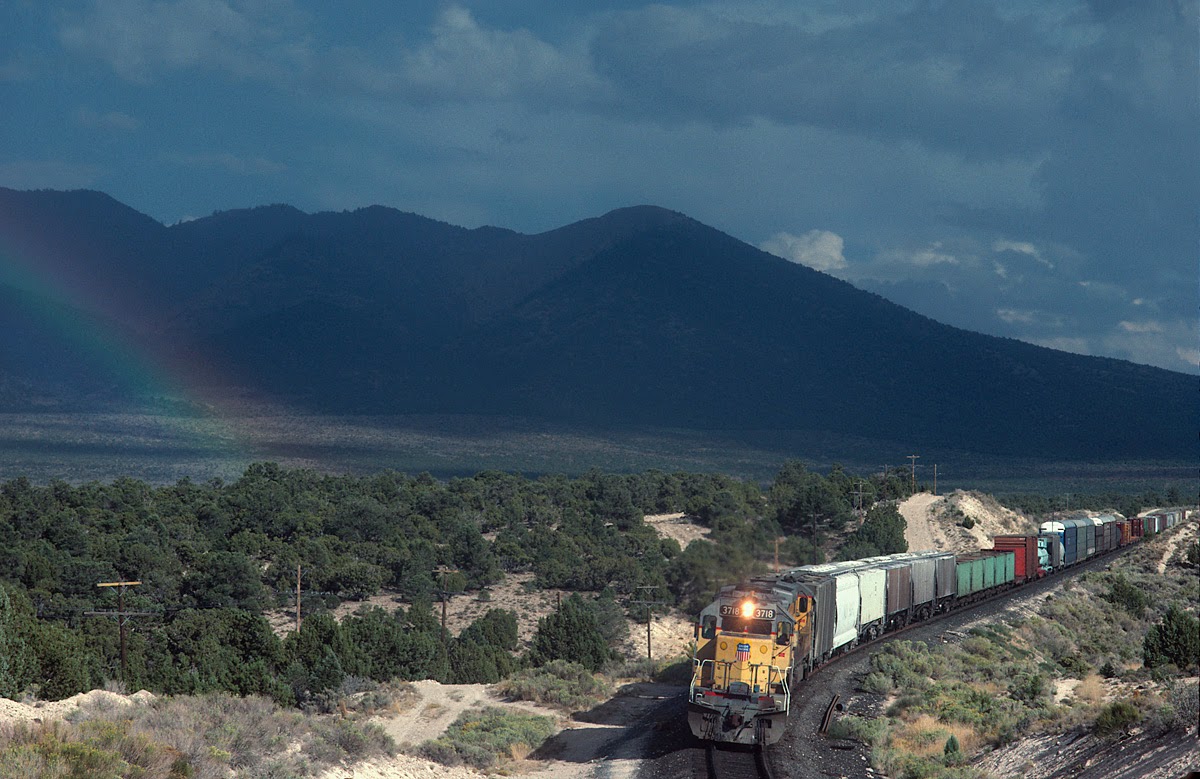
On this day, September 5, 1990, I'm near Lofgreen siding as the eastbound LVSC (Las Vegas-Salt Lake City) long-distance division local descends the grade behind an SD40-2 and C30-7. It'd been raining here moments before, and the clouds have parted to bathe the scene in a mixture of sunlight and shadow, accented with a fleeting rainbow. The air is rich with the smell of rain, wet sage, and mountain juniper. The bright yellow locomotives just complete the scene.

I wish I was back in those mountains again today. It'll have to wait until a vacation sometime in the future.


Wednesday, February 26, 2014

Welcome to the Northwest! Yakima, October 1976

My first BN train photographed as a Washingtonian: Ellensburg turn returning to Yakima behind GP9 1728 and F7A 704.

I'm sure the jaded railfan in 1976 would have seen the railroading world as getting more homogenous by the day, with mergers and abandonments sweeping away hallowed traditions. Just that year, ConRail (originally with the uppercase "R") consolidated a number of colorful bankrupt railroads in the east (along with Penn Central). Only six years before, the four major northern tier railroads merged as Burlington Northern.

In October that year, my family moved from Salt Lake City to Seattle. I was only 16, so I wasn't jaded yet; my whole railfanning world had consisted of Rio Grande and Union Pacific, so the opportunity to move to a new corner of the country and experience new railroads was pretty exciting to me.

We left for our new home early on October 8th, spending the night in Boise. Any trains I could expect to see would be familar, as southern Idaho is still "Union Pacific," and indeed, we paced a train that afternoon for a few miles near Glenns Ferry behind the usual mixed-bag locomotives I'd seen in Salt Lake City: GP30, SD24B, GP9B, U30C. Dad was nice enough to keep the LTD throttled back so I could lean out the back window and snap a few pan shots, then we scooted off to Boise, where I was given a few minutes to explore the classic Moorish Union Pacific depot on the hill  overlooking downtown. It was largely a corporate showpiece at the time, as there'd been no passenger service to the building since 1971, and regular Amtrak service via the Pioneer wouldn't begin til the next year.

The next day would've been a great opportunity to see more Union Pacific, paralleling the railroad across the Blue Mountains, but if I saw anything, I don't remember it. We overnighted that Saturday in Yakima, the idea to ride the resurrected Portugese trolleys operating on the electrified Yakima Valley Transit, a tourist service restored in time for the Bicentennial year.

After getting the family settled in at the hotel, dad trusted me with the keys to to the car and let me head off and explore the city's railroads. Yakima was served by a Union Pacific branch from the Tri-Cities area, and of course was a division point on BN's former Northern Pacific mainline between Auburn and Pasco. Fruit and lumber were the primary traffic staples, BN had a couple branchlines generating from the Yakima area;Union Pacific was fed by its Yakima Valley Transportation subsidiary, still amazing operating with steeplecab electrics.

I was in luck: I immediately stumbled upon a GP9 and F7A returning from Ellensburg on a BN local, a few carloads of saw logs ahead of predominantly ballast hoppers. Nearby, a Union Pacific GP9 switched in the yard--nothing new there. I followed the YVT trackage imbedded in the street north towards Selah, the current TRAINS magazine handy on the front seat next to me, open to Ted Benson's timely article on the YVT. I parked the car and walked up the short but scenic canyon along the Yakima River, hoping to somehow luck onto a YVT train returning from Selah--no luck, but I did stumble onto eastbound Amtrak "Empire Builder" behind a pair of SDP40F's and a dozen cars including three domes. Pure class!

Heading back into town, I finally found the YVT returning from west of Yakima on Tieton Drive, brakeman riding the front beam of steeplecab electric 298 easing down the middle of city streets delivering interchange to Union Pacific, two 57 foot mechanical cars that dwarfed the little motor up front. The crew worked quickly, picking up a string of cars for Selah, and they soon departed north up North 6th Avenue. I followed them until the sun had set, reluctantly leaving to meet my promise to be back to the hotel in time for us to go out to dinner. What a fabulous introduction to Northwest railroading! And all that in just a couple of hours!

The trolley ride the next day was anti-climactic. But you can bet I was quick to unload the darkroom equipment and process the film as soon as the moving truck arrived the following week. Again, haste made waste--the exposures were largely cooked and the film over developed.

And strangely enough, even though YVT continued electric freight operations until 1984,this was my first and last visit to this amazingly photogenic operation. Shame on me!


 Familiar to a kid from Utah, Union Pacific GP9 300 switches in Yakima yard, VYT's trolley barn in the background.

On-time eastbound Empire Builder between Selah and Yakima behind SDP40Fs.

 Ripping off a similar Ted Benson view in TRAINS: YVT 298 "sneaking up on the motorist" in the streets of Yakima.

 YVT 298, dwarfed by a following PFE mechanical reefer, arrives at the UP interchange.

 End of the day, and YVT 298 delivers to Union Pacific.

Tuesday, February 25, 2014

Slipping off the Learning Curve: on becoming a teenage railfan.

Photographers often hear the phrase: "You're only as good as your last picture." Well, this post isn't about my last picture. It's about my first. Maybe not THEE first (I believe those were done on a hand-me down Kodak 126 roll camera, and who knows where those are), but at least the first efforts I made in putting railroads to film.

So, maybe the appropriate phase here is: "Show me the shittiest photographs you can imagine of trains."  And I can probably meet that expectation and raise the bar a few notches.

Another phrase here comes to mind, that of the big room filled with a million monkeys banging away on typewriters: eventually, the saying goes, one of them will just happen to produce a best-selling novel.

No monkeys here. No novel. No typewriter. But maybe a million photos down the road, I've ended up with a few pretty good ones. And this here is where it all started.

Now, excuse the self-indulgence, because this posting is entirely self-indulgent. If you've come for great photographs, you won't see them in this posting. But maybe, if you're a photographer yourself, you can relate to how I got into this hobby, and you too will remember the months and years of struggle to get up that steep learning curve and begin to make some photographs that don't end up getting filed in the cabinet for forty years.


The First Roll
 So, here I am in my way-cool imitation leather jacket, striking a pose for my dad in front of Union Pacific 4-8-4 833, which was retired to Pioneer Park in downtown Salt Lake City. I am 13 years of age, and have yet to get braces. And thank God I did. I'd just gotten a Mamiya/Sekor 500TL 35mm SLR camera with 50mm lens for Christmas 1973, and my father has driven me from our east bench suburb to gritty downtown SLC--vagrants! Pan handlers! And as I was later to learn, gay sex in the bathrooms. I saw none of it.  I just wanted to try out this new camera.


Most of the shots on that first roll of film filed in the "railroad" collection are abysmal. This one actually turned out okay: GP20 493 and a couple of switch engines at UP's North Yard engine facility. Whenever dad had an errand downtown, I'd come along, and we'd drive by the shops and see what was around. There was a fascinating variety on the UP back in those days. And only occasionally we'd get tossed off the property. We didn't have a problem with that this day.


My Sister, the Taxi Service 
Without a driver's license, I really had no way to scratch that itch to make train photos, being as I lived probably 10 miles from the closest railroad tracks. So, along with trips downtown with dad, or family vacations boating (with any luck, there'd be some train tracks nearby), I occasionally begged my older sister Ronnie to take me out. Since she was five years older than me and toting around her kid brother was definately NOT cool, it didn't happen too often. But somehow, she ended up being my chauffer on a February afternoon in 1976. I'd heard on KSL radio that a Union Pacific ore train had scattered all over the ground around 20 miles north of Salt Lake City, near Kaysville. Amazingly, she drove me up there, and not too long after arriving and surveying the wreckage of the ACUW ore train, along came a southbound led by DDA40X 6905. Welllll, farrrr out!, as the catch phrase by singer John Denver so popular about that time went. I think this was probably the first action photograph I made that was reasonable sharp. I might mention that at that time, I had the local drugstore process my film. It wasn't spectacular, but it was consistent.


Travels With Stan

Not too long after this, I started to attend the monthly meetings of the Promontory Chapter, National Railroad Historical Society. Then, as now, it was largely populated by elderly men who bemoaned the end of the steam era. But where else would you find a concentration of other people in Salt Lake City who loved trains? I discovered one of my high school classmates was an attendee with his father; we kept our railroad interest secret at Skyline High School, for being "outed" as a train buff surely would be as traumatic as being accused of being a high school smoker. Hey, it was Utah. One of the few younger guys in the group was Stan Jennings, probably early 30s. He liked going out and photographing trains, too, and was tolerant of having me along, so with Stan I made quite a few trips into the hinterlands. 
 One good thing about the NRHS, apart from the monthly slide shows, were the contact made and information gleaned from others. We learned of a Union Pacific officers special coming back from Los Angeles, and Stan and I spent the day waiting for it west of Salt Lake City, chasing it back to town and photographing the two E9A's leading the train off the Provo subdivision/"Passenger Line" on 300 West Street.  

Stan and I also photographed Union Pacific's Park City branch, and the local that operated it behind sets of GP7's and GP9s. The crew was friendly, and part of the day was spent riding the train while it switched the phosphate load-out facility at Phoston. It was right about this time that I graduated to processing my own film in the downstairs bathroom--talk about trial and error! When the results were good, they were far better than the drugstore film developing, but once more I bumped up against that learning curve and more often than not, I'd either under developed, over developed, or somehow damaged the film while processing. This didn't help matters, as my exposures were all over the place, which I can now attribute to following the built-in light meter. I'd follow it, as photographer friend Mark Hemphill would so aptly put it years later, "right into the ground!" Indeed. I'm amazed I was able to salvage and of the images from some of these trips

 Thanks to Stan, I was able to make my first trips to Soldier Summit, though, once again, my inexperience with exposure, holding the camera steady, and composition made the results quite disappointing. I did manage one or two frames where the Rio Grande Zephyr remained reasonably sharp; let's not mention my experiences on a beautiful afternoon following the westbound Utah Railway coal loads right into the sunlight down Soldier Summit in July 1976--blurry, out of focus, and over-exposed by several stops. 


The Sandy Local


The nearest tracks to my house were Union Pacific's Provo subdivision, which paralleled but were just a couple blocks east of the much-busier Rio Grande mainline between Salt Lake City and Provo. This was about 10 miles due west of our home in Holliday, an hour by Schwinn Sting-Ray down 4500 South Street. I made the trip a few times, usually stopping by Art Chase's home on the way. I met Art, who was my age, through the Golden Spike Model Railroad Club, and if we didn't spend the afternoon running his brass model of UP 8444 around his 22" radius curve on the layout wedged into his tiny bedroom, we'd head over to the tracks and see if we could find the the only train to operate on this line with any regularity, the Sandy Local. Art knew the crew, and we often ended up riding around for awhile on the EMD switch engine. I have no idea, in retrospect, why we didn't walk over to the Rio Grande to see more trains. Today, this UP line has been rebuilt by Utah Transit Authority and is used for a light-rail route to Draper.


Travels With Dad
 It was my father who really nurtured the railfan/photographer in me. He encouraged me accidentally by leaving issues of TRAINS magazine around when I was barely reading age, and when the model railroad bug hit about the same time the photography bug did, he spent many hours painstakingly building a 4 X 8' model railroad for me. Those trips downtown usually included a stop into Keith's Hobby House to check out the amazing basement model railroad department, and then there were the boating trips to Bear Lake in Idaho, where one night on our week-long vacation we'd drive into Montpeiler for a steak dinner, stopping by the Union Pacific there to look around. My dad was a regional sales representative for a pharmaceutical company, and his territory included southwestern Colorado--including Durango. So in the late summer of 1976, he took me along on a sales trip, highlights of which were putting me on the Rio Grande narrow gauge train for the day between Durango and Silverton--still operated by Rio Grande at this date!--and picking me up in the afternoon. It was a great week, seeing my dad at work and meeting his coworkers, seeing him in HIS environment. And it wrapped up with me riding the Rio Grande Zephyr home to Salt Lake City from Grand Junction. The Silverton Train, though--back in 1978, still operated by K28 Mikado's with fake diamond stacks and the two trains a day pulled right up into town while passengers shopped and ate lunch. Quite a change from the operation today!


Travels With Mom

My mother was amazingly tolerant of her son's railroad photography. She shared her laundry room, afterall, with my Durst F30 enlarger and stinky, messy chemicals. And more than once she took me out of school for the day to take me to various "must see" railroad events such as the Freedom Train and several iterations of Union Pacific Passenger specials. With her, I rode family day trains behind NW2's and GP30s--such as this push-pull set in 1976 north of Salt Lake City preparing to head back to the downtown depot. And with learner's permit in hand, she suffered through my driving her bright red Mustang convertible down Weber Canyon at 90 miles an hour to get back ahead of a UP Old Timer's special behind A-B-B-A E-units. THAT was a battle of wills--hers vs. mine! She finally dumped me off with Steve Sequine and Jim Belmont to chase it the rest of the way to Salt Lake City, though Steve's Camaro was quite a bit faster than mom's Pony.

Travels on My Own
 By the late summer of 1976, I'd finally gotten my driver's license. Not too long after that, my folks left for a long weekend "business convention" trip to the Bahamas or Hawaii or Disneyland, leaving me and my little sister under the iron thumb of an old woman we called "Mrs. Yaztee" for her love of the dice game. I was allowed to drive mom's mustang to work, but it wasn't long until I snuck out of the house before sunrise several days in a row to go exploring. The open road was finally mine, and I made the most of it, exploring the Salt Lake Valley: the Rio Grande Zephyr, the Midvale Tramp and its SD9's, and the curiosity of Kennecott's Bingham Canyon mine operation and "low line" heavy-haul electric railroad. My camera technique was still not up to my ambitions, but I saw a lot of operations I wouldn't have seen otherwise. Was it worth it, the punishment for taking the car and putting a few hundred unauthorized miles on the odometer? Hell yeah. Absolutely.


On Meeting Mr. Schmid
Looking back nearly 40 years, I now see September 9, 1976 as being an important day in my development as a photographer. It was a chance meeting with a young photographer from California that made me realize that rail photography didn't have to be only a hobby, but rather it could be a lifestyle, a zen-like pursuit to make the best photograph you could using all the resources and tools available to you. From that day forward, I don't think I approached rail photography the same way again.  

I'd just found out we'd be moving to Seattle the following month, my father taking a promotion in the company to Regional Sales Director. I'd spent the day making one of my last trips to photograph trains downtown, and by accident had happened across the long-haired Californian in a VW Baja Bug taking in the action near Grant Tower, Salt Lake City's primary rail junction. At an inopportune time, a UP transfer drag from Roper Yard had stalled strung out through the bottleneck of Salt Lake rail operations, its single EMD switcher unable to keep its heavy train moving through the tight S-curve in the interlocking. UP's yardmaster sent a second switcher, and when this failed, sent a third. Three tries, and finally the ponderous drag was moving, three locomotives, three crews, and an interlocking once more fluid.  The photographer and I got to talking, and I learned this Berkeley postal carrier, Jamie Schmid, was deep into his yearly month-long trip throughout the west. A whole month? Photographing trains? I was dumbfounded. He slept on the ground next to the track. He used a slew of Nikon F-series cameras and lenses. He had a scanner. And he carried a notebook of hand-drawn topo maps. Clearly, this guy was dedicated.  I had to learn more. Without approval from the higher ups, I invited him to stay at our house, and he took me up on the offer, a bit worried, though, that perhaps I should check with my parents. It'd be okay, I assured him, and breathed a big sigh of relief when my mom said it'd be okay. I had the coolest parents, and Jamie agreed. 

We stayed up late that night discussing railroads, photography, the hobby, and a lightbulb went off above my head. This is what I need to be doing, I told myself. I traveled with Jamie the next couple of days, up to Ogden and out onto the Great Salt Lake causeway, then down to Soldier Summit where we did an after-dark chase--no photos, just diggin' the experience--of a heavy Utah Railway coal train down the mountain. The dynamic brakes on the RSD15's up front glowed orange in the night. It was spell-binding.

As one period of my life was ending, another was beginning. It was this encounter that set me straight on the opportunities for exploration in my new home in the Pacific Northwest. And I remember it like it was yesterday. Jamie's work has been an inspiration to me ever since. And I'm fortunate to count his as one of my longest-lasting friendships.


Monday, February 24, 2014

All Hail The Warbonnet!

Zooming northbound on an empty grain train, BNSF 8241 still wears its Santa Fe name and warbonnet paint scheme at Ponder, Texas, on February 21, 2014.


It's almost UN-AMERICAN to not love the silver and red Warbonnet paint scheme created for the Atchison, Topeka & Santa Fe Railway back in the late  1930s for its first streamlined passenger diesel locomotives.

It became an icon of American industrial design, and symbolized the railroad and its ties to the desert Southwest.

It wasn't only worn on streamlined passenger locomotives--it appeared in the late-1960s on diesels designed for freight service but equipped with boilers to handle the passenger trains. And a variation of the paint--nicknamed "blue bonnet" or "yellow bonnet," depending upon the predominant color used--became the standard freight colors of the railway too beginning in the early 1970s.

In the final years of Santa Fe, before merger with Burlington Northern in 1995 to become BNSF, Santa Fe president Mike Haverty resurrected the silver and red, much to the collective orgasms of railfans everywhere. Hundreds of new locomotives were delivered in the scheme as part of a marketed "Super Fleet" of locomotives supposedly dedicated to Santa Fe's reliable, premium-priced intermodal service. The final locomotives to wear the Warbonnet in its original guise, ten FP45's delivered in 1968, were returned to their original colors. Soon to follow: GP60M's and GP60B,s B40-9W's, several models of big new General Electrics, and--the last new locomotives delivered to Santa Fe--SD75M's.

BNSF's first few years--the railroad was actually named Burlington Northern Santa Fe before renamed into something less meaningful but just as much a mouthful to say--was rife with struggle between the "Red Team" and "Green Team." The railroad initially didn't show a unified corporate image with its new locomotives, as new locomotives appeared in the "Grinstein green and cream" of its SD70MAC coal locomotives and "Heritage One" C-44-9W's wearing a Great Northern-inspired green and orange. But the Warbonnet wasn't dead yet, even with the demise of the beloved AT&SF: more SD75's, and GE C-44-9W's arrived in the silver and red, albiet wearing BNSF initials.

By 1997, though, BNSF had settled on a single unifed scheme, merging the green and orange of the Heritage One paint with the "Warbonnet" nose piece. It was deemed "Heritage Two."

Today, a decade and a half past the merger, that silver and red Warbonnet is still represented on the BNSF roster, although becoming more worn and tattered with each passing year. Many of the locomotives delivered in the Super Fleet Haverty years have been repainted, several have left the roster, but it's still not uncommon to see one of the ragged survivors.

The other day, while aimlessly wandering on a beautiful late winter day using "photography" as an excuse to get out of the house, I stumbled upon one of the last of the Santa Fe SD75M's delivered. Originally  ATSF 241, it wears its BNSF-applied road number 8241. In a twist of irony given its longevity, the locomotive will soon be renumbered back to its original Santa Fe number as hordes of new General Electric locomotives entering service encroach upon the 8200-number series.

Rusty and faded, but apparently fully amortized, the 8241 has returned from storage, the SD75M's among the "worst performers" on the roster as a locomotive class when measured by MTBF--Mean Time Between Failure.  They've been counted out as gone for good before, but a locomotive shortage brought on by a harsh winter, insufficient train service employees, and a traffic upswing exacerbated by new crude oil traffic has brought them back out on the road.

How long will they last this time? Take a good look, because nothing is for certain anymore in Today's railroading. The Atcheson, Topeka & Santa Fe didn't last forever--neither will the locomotives that nearly 20 years after its demise still wear its honored name.


A year after Santa Fe ceased to exist as a railroad, newly-created BNSF continued to deliver locomotives in its iconic red and silver "Warbonnet" paint, seen on brand-new SD75M's 8270/8268 at Buenos, Texas in March 1996. Trailing are two Santa Fe locomotves in the derivative "Yellow Bonnet" scheme.