Tuesday, May 5, 2009

OZ Day 4(b): Aussie Dispatchin'!


Inside the airy, spacious, uncrowded ARTC Broadmeadow Control Centre: they're not overly concerned about pod walls with pieces of paper stuck on them that "reflect noise" and don't "look professional". . .


PM, Tuesday, April 14: Since Lance and I are train dispatchers here in the states, it's only natural that we'd be curious as to how our counterparts in Australia do the same job. So, with the help of Pacific National yardmaster Gary Nicolle, we were put in touch with Joe Costello, a train controller (dispatcher) for Australian Rail Train Corporation, the company that has the responsibility for scheduling and controlling movements across 4400 kilometers of standard-gauge railway across Western and South Australia, Victoria and New South Wales states.

ARTC was formed in 1997 to administer access and maintenance across the network that had recently been "opened up" to competition among railway operating companies.

ARTS has two control centres in NSW, out in Junee, in far west, and at Broadmeadow, a suburb of Newcastle, around 90 miles north of Sydney. Broadmeadow's responsibility extends from the Queensland border to Newcastle, north and west including the lines to Moree and Tamworth, across to Dubbo and Cobar, and on the Main West line from Lithgow to Parkes and associated branches. The railway from Broadmeadow through Sydney and south to Nowra on the coast, Campbelltown in the southern suburbs, and across the Blue Mountains to Lithgow is administered by RailCorp.

Joe met us at the front door, and after signing in, let Gary, Lance and myself to a very informative tour of the Broadmeadow facility, lasting nearly two hours. We would've stayed longer, but we'd told Charlie and Paul we'd be back to join them for dinner. As we discovered, though, train dispatchers just love to bullshit, compare notes and generally complain about the company, their fellow dispatchers, and the train crews. But in a nice way.

While Broadmeadow is a much smaller facility than our BNSF Network Operations Center, their function is the same. Within one room are train controllers, managers, and support personnel to help smoothly expedite train movements. The office is split up into about a dozen territory desks; some jobs are relatively compact and high-density in train movements, as in the lower Hunter Valley with numerous passenger movements and coal trains in out of the port. Other jobs are somewhat disjointed and their territories are scattered and not always contiguious.


Joe shows us a control train graph. If you know how to decipher this, you can replay the entire day's events on a section of railroad. . .


A close-up of a train graph: diagonal lines are trains moving across the territory. Delays are noted in pen. Red boxes are train authorities--"possessions"--for rail workers. A lot of work, sure, but I bet their dispatchers have a better understanding of what's going on at any one time than most dispatchers in the states. . .

One big difference between BNSF dispatchers and their Aussie counterparts is the planning component. We were surprised to see such a reliance on "train graphs," a representation of traffic across a territory described by lines moving across an X and Y axis representing distance and time. Controllers at Broadmeadow plan out their railroad well in advanced using these graphs which are generated at midnight each day with the "paths" of contracted train movements lightly printed across the sheet. These are the "ideal paths" that these trains will operate upon. Yes, Australian trains are highly scheduled--since the access is "open," each operator must have an equal opportunity to access, and scheduling trains to slots with specific running times between sections, required maximum train lengths, trailing tonnages, and adequate power to move the trains to the schedule are all important for the network to run as planned. It's fascinating to us as purely (well, mostly) reactive train dispatchers to see the railroad unfold in advance on the train graph. Each dispatcher's station includes the big train sheet, numerous colored pens and pencils, a healthy eraser and a drafting triangle.


Overview screen for the train authority computer, automatically updates the location of trains via the GPS on locomotives and advances their location on the graph. . .


The Train Order screen at ARTC. Very similar to our own TWC, but with a lot less repeat scenarios that could result in errors. . .

Their issuance of Train Order authorities was much more streamlined than are cumbersome TWC. The computer generates an automatic authority "key" of five numbers, non-sequential and not specific to district. Once the authority has been given, the number key becomes hidden as a security against accidentally releasing a wrong authority

Communication is done via telephone handsets, not headsets. . .

The issuance of authority through CTC and Train Orders (i.e. Track Warrants) is very similar. The hardware and software is very similar to the TMDS we use (though hopefully much-less error prone!). Unlike our CTC, it appears the ARTC installations permit "call on" restrictive signalling to expedite movements back to trains in switching situations (we have to verbally authorize by a red block). Interestingly, though, the CTC we saw in operation on our trip didn't have intermediate signals, in effect creating a CTC-controlled Absolute Block railroad. On the double- and four-main track Hunter Valley line, dispatchers also controlled a CTC railroad with absolute signals but no crossovers. . in the states, we'd have automatic block intermediates in this instance, and there would be numerous crossovers to "sort" trains out.

Communication is done controller-to-train, instead of controller-to-radio tower-to-train. Each locomotive has a unique radio address the controller to contact, and their precise location is given via GPS. . .
And i'll give the Australians big props on this one: controllers talk with train crews via telephone--when a train is ready to depart, they activiate the radio/telephone on their lead locomotive, which becomes a GPS marker as well. Train controllers contact trains by dialing the lead locomotive. Communication is clear and private, without other interference from hand-held open-access radio channels. Imagine that!

Typical work station, with radio console, and CTC panel displays. . .

ARTC controllers earn about what we do at BNSF. They work 6 1/2 hour shifts, get six-week vacations to start, and rostering according to jobs a controller knows rather than seniority is how shifts are filled. Dispatchers work up from grades 1-4 depending upon knowledge of jobs, and pay is raised accordingly. And the atmosphere at ARTC was very good-natured and low-key: no uptight asshole managers running around with their heads cut off. Dispatchers could wear shorts to work as well. Imagine that! And it didn't effect safety on the trains!

The whole feeling was sort of what the small offices at the BN were like before the merger and office consolidation. I'm wondering if they're hiring. . .and if they include a good moving package!

Another view of ARTC Broadmeadow: looks like a nice work environment.

It was getting late when we cut the tour off. Charlie and Paul had already eaten dinner, and were joined by Stuart Ellis, editor of Motive Power magazine and a driver for Pacific National. The kitchen at the Belmore was soon to close, so we invited Gary and Joe to join us for another round of Schnitzel and phoned in the order so it'd be ready when we got back. You can only imagine, with three drivers, a yardmaster and three dispatchers how much jawbonin' and bull-shittin' were going on until late in the evening in the dining room at the Belmore. It was another great day.

Monday, May 4, 2009

OZ, Day 4: Pelton Coal, Duralie shuttles. . .

IMG_3318 Four 48s at Greta. . .check out all that stuff on the roofs: airconditioners, GPS dishes, etc. . .

Tuesday, April 14:  A couple of our objectives for the trip were within striking distance of Maitland: the Pelton coal trains which used PL and 48 Class Alcos running on the former South Maitland Railway; and the QRNational Duralie coal shuttles, operating on the North Coast line about an hour north of us.

One of our spies told us that an empty had been called out of Port Waratah at 3am for loading. . .it being the Tuesday after a long holiday, we assumed there was already one out there, ready to go with the start of the work week. Our first stop was SMR’s East Greta Junction signal box, at the junction between the SMR and the ARTC’s Hunter Valley mainline (Australian Rail Track Corporation is the entity that adminsters the Government-owned rail infrastructure).

SMR, surprisingly, is still an independent railway, one of the few in the country. However, trains over it are operated by Pacific National. SMR was once the vital mainline for much of the area’s coal hauling, back before many of the mines played out and the heavy mining moved up the Hunter Valley. Portions of SMR were double-tracked, and numerous branches left its mainline for dozens of collieries in the area. SMR is perhaps most famous, though, for its late use of steam locomotives—1985, the last in Australia.

IMG_3224 

SMR’s East Greta Junction signal box: a holdover from the steam-era.

IMG_3231

Manually-operated crossing booms!

IMG_3236 

Dig those puzzle switches in the shunting yard!IMG_3228

And old-school manual lower-quadrant interlocking signals!

It doesn’t look like much has changed since then on the SMR. The railroad still operates using a staff-and-ticket system; the interlocking at East Greta is still protected by armstrong points and ancient lower-quadrant semaphores; puzzle switches in the yard; and manually-lowered boom-type crossing gates. This kind of stuff you don’t see in the U.S. anymore. And much of this kind of old infrastructure of the steam era is still found along its right-of-way: water tanks, signal boxes, brick-edged station platforms.

The towerman confirmed our suspicions: there were two trains at the mine, one ready to go shortly. We beat-heat towards Pelton, around 20 miles away, most of the miles not along the tracks. We left Cessnock just as the 38-car first train was starting up the grade out of the mine, and we reversed direction to wait for him at the old signal box at Neath. The chase wouldn’t be difficult, as he was limited to 30kph (20mph).

IMG_3249IMG_3253

Charlie kept his eyes to the skies, where the sun threatened to come out. . .the cameras stayed in the car, though. . .

The clouds were trying to break up; the sun was touch-and-go; Charlie would walk around, squint up through the clouds from time to time, and keep his cameras in the car. Finally, the train arrived, pushing a sun-break with it. . .the locos barely on the edge of the clouds as they passed the box. The power was four 48 class Alcos, the leading unit one of the seven butt-ugly PL-class “Port Link” chop nosed units which lead these trains most of the time.

IMG_3262

This first train literally pushed a break in the clouds along. . .

IMG_3267

as it passed the old signal box at Neath. . .

IMG_3295

and beside the old water tank at Weston. . .

IMG_3310

skirting a paddock at the old location of Greta. . .

We shot the train at several easily-accessible locations on the way back to East Greta Junction, where after dropping off the paper ticket, the driver opened up on the throttle of ugly-as-sin PL5 and let the smoke fly!

IMG_3328

Chopped nose or not, the PL5 still smokes like an old Alco!

IMG_3362

The morning’s second Pelton train returns the staff to the towerman at East Greta Junction. . .

The second train departed on the arrival of the first at East Greta, so we doubled back and eventually found him getting a relief crew at Weston; we shot him going through Greta and passing the staff back to the towerman at East Greta, PL2 leading two un-chopped 48 Class.


IMG_3379

Standard power, a pair of 82 Class, led northbound empty for Craven near Wirragulla.

UP THE NORTH COAST TO DURALIE

Just then, a northbound coal empty headed through the junction with the North Coast main at Telarah behind a pair of 82 Class—standard power. This train was en-route to Gloucester Coal’s Stratford reload at Craven, around 50 miles north of Maitland. Coal at this mine was mixed with coal brought up from another mine at Duralie (DOUGH-rally) for washing and blending. The shuttle between Duralie and Craven was on the “must shoot” list: the train ran push-pull with a mix of ex-Queensland narrow-gauge 423 class and ex-NSWGR 421 class bulldogs. Lately, it’d been running with 2 423’s on one end and a 423/421 pair on the other. We figured we’d have a one-in-four chance of getting a good shot of a bulldog leading, one way or the other.

IMG_3393 

Beautiful countryside near Wards River. . .

We chased the empty north, shooting it in a couple of locations. The road was twisty, turny, under construction in places, and not all-together fast nor direct. The scenery was spectacular, however, a mix of Western Oregon and the Northern California wine country.

IMG_3381

What’s for lunch at Stroud Road? Beats the hell out of me!

We stopped at a quaint little take-away place in Stroud Road for lunch; a bewildering array of sandwich choices was offered, most of which I hadn’t a clue: Spider sandwich? Devon sandwich? Plutos-Chickos-Spring? No worries mate; I invoked Yank tourist take-away rule number one: I’ll take the sausage roll! But the lunchtime crowd was so big the single employee couldn’t keep up with the demand. We didn’t want to lose our Duralie, which was to follow the empty north out of the the mine, so we bagged on the fresh-cooked and bought a bag of chicken-flavored potato chips and a coke instead.

IMG_3403

The Duralie, working push-pull: 2 423’s up front. . . .

IMG_3407 . . .and naturally, the 421 buried at the rear.

IMG_3413

However, we were undeterred at getting a pan shot of the bulldog. . .

The rain came and went, and our Duralie train left the mine, two 423’s up front and the 421/423 set on the rear, the bulldog, alas, buried. We followed him to Craven, getting a nice break in the rain and clouds for a “storm light” shot, and waited for our empty to load out and depart. It was getting late; we had plans for the evening in Newcastle and had to start getting back.IMG_3421

Duralie load in storm-light at Craven: finally, some sunlight!

Lance and I dropped Paul and Charlie off at the Hotel, and we set off for the ARTC Broadmeadow Control Centre to meet Gary Nicolle and Joe Costello for a tour of how Aussies dispatch trains. But that’s the next installment.

Sunday, May 3, 2009

OZ Day 3: Chasing the Outback Aurora

IMG_3139

A vision from the past, at Georges Plains. .

Monday, April 13:We were up before sunup—but really, who could tell when that was with the heavy overcast and light rain falling?—so we’d be ready for the departure of the 14-car Outback Aurora, a leisurely four-day circle trip operated by the Rail Transportation Museum in Thirlmere from Sydney, up the North Coast to Coffs Harbour, back down and across the Liverpool Range, thence across the line through Binnaway and Dubbo out to Cobar before reversing directions and heading back to Sydney via the Main West.

IMG_3078

Pensioners await the departure at Orange. . .

The train was mostly a stainless-steel train set constructed for the 1962 Southern Aurora, which inaugurated Sydney-Melbourne passenger traffic when a through standard-gauge line was opened between Australia’s two largest cities.

That we saw this train at all on our trip was a happy accident well after we’d booked our travel, when I stumbled across the RTM website with details of the trip. Immediately, its lure of vintage NSWGR diesels across the Southern Highlands put it at the top of our “must do” vacation list, the anchor from which we’d plan the rest of our journeys.

 IMG_3057 The builder’s plate was a fake, but everything else was the real deal. . .

Right on time, right around 0700, DL600B 4490 led Clyde-GM 4916 and Goninan Alco-GE 4306 to a halt at the Orange depot, where the passengers—mostly nearing retirement age and probably veterans of previous RTM trips—got out to stretch their legs. Lance and I donned our spiffy high-visibility orange vests and walked toward the head-end, blending in with RTM staff also wearing their orange vests. We looked like we belonged “within the corridor,” and usually, that’s what mattered. Charlie, being a “3/4 full-sunlit” kinda guy, left his cameras in the car. In fact, they didn’t come out the whole day.

Lance and I drooled over the vintage diesels:

IMG_3038

DL500B 4490, the last 44 Class to operate when withdrawn in late 1994;

IMG_3049

4916, a “Aussie GP9” branchline unit built in 1964 wearing the early 1980’s State Rail Authority “Candy” scheme

IMG_3051

4306, truly exotic, the only survivor of six 43 Class, built in 1957 complete with already-passe’ Alco 244 prime mover and the unusual GE Erie nose used on the GE 750 test-bed locomotives built in the U.S. in 1954.

IMG_3044Lance was in heaven. . . 

We set up on the Franklin Road overpass, just east of the Orange North Fork signal box, and photographed the train’s departure—AMAZING! Smoky, as you’d want from Alcos; bone-jarring as well, two flavors of Alcos and a roots-blown EMD definitely blowing out the carbon, both in their manifolds and our memories of what it used to sound like in the U.S. thirty years ago. It was the ghost of the Central Highlands Express!

IMG_3089 Roaring out of Orange. . .

We spent the rest of the morning ably guided by Charlie chasing the train back to Lithgow, photographing it in more than a half-dozen nice locations as it climbed over the highlands up Tumulla bank, down to Bathurst, and then into the Blue Mountain foothills through Brewongle, Tarana and Sodwalls. Lance did an excellent job driving. And, no, Emily—if you’re wondering, there was no “shit driving.” Lance kept to the speed limit the entire day. ;-)

IMG_3106 Topping the first climb out of Blayney at Newbridge. . .

IMG_3164 winding through an s-curve at Brewongle. . .

IMG_3182

passing the preserved station and water tank at Tarana. . . 

IMG_3191 IMG_3195 and coming and going through the horseshoe curves at Sodwalls. . .

We left the train behind at Lithgow, caught a sandwich at “Red Chook”, then got caught up in the Easter weekend traffic jam en route to getting back over the mountains to pick up Paul Reid, the last member of our traveling group, from his home in Emu Plains. The skies opened up as well, pissing rain, further clogging our progress. Charlie opted for another back-road re-route, taking an alternate route to Richmond, where Paul’s wife had driven him to meet us. We loaded up, and drove the highly-scenic, narrow, twisty, rainy and remote “Putty Road”—highway 69--between Richmond and Singleton, where we back-tracked on the New England highway to Maitland, where we had a reservation for two nights at the Belmore Hotel, a two-story Art Deco pub on High Street in Maitland’s downtown. We arrived in time to claim our upstairs rooms—typical of country pubs, guests shared separate male and female bathrooms—for a paltry $50 a room/night—around $20US for each of us. We dined on a wonderful plate of chips, veal schnitzel and salad for $10.50AU in the downstairs dining room while Paul and Charlie provided narration of the National Rugby League and Australia-South Africa cricket matches competing on the big flat screens. Great meal, great company, and a great way to further absorb Australian culture.

Saturday, May 2, 2009

OH! The Humanity!

In an oddly-metaphorical event, the Dallas Cowboys' air-filled practice bubble collapsed during a thunderstorm at Valley Ranch this afternoon, trapping several rookie prospects and injuring a couple of coaches and media types.

Needless to say, the entire DFW media is breathlessly glued to this horrible event, even as the storms have moved east of the area with tornadoes reported. Tornadoes? But what about Dem 'Boys?

In the midst of the collapse, strangely, Tony Romo was nowhere to be seen.

Perhaps this is a sign from God or something?

OZ, Day 2: Glorious Bulldogs!

IMG_2921 IMG_2919

We bag our quarry off the overpass. . .

April 12, 2009: Our Aussie vacation was unabashedly a Railfan trip. Okay, make it 75% Railfan, 20% Model Railroading, and 5% tourist. That’s not to say we weren’t immune to oohing and aahing at the traditional tourist sites, but they clearly weren’t our prime objective.

Now, 50-year-old GM bulldog locomotives—THOSE were prime objectives.

So, bright and early on Easter Sunday, while others were celebrating the Resurrection of Lord Jesus Christ, Lance and I were celebrating the continued revival of three 1952-built Clyde-EMD Victorian “B Class” locomotives under the ownership of Chicago Freight Car Leasing of Australia (CFCLA), a purveyor of a large fleet of varied and interesting locomotives hired throughout the country by rail operators.

Railfan grapevine—and believe me, it’s strong and healthy in New South Wales, given the number of professional railroaders who are also rabid Gunzels—had it that CFCLA’s three standard-gauge B’s were working a concrete sleeper train for Rail Corp, the Sydney Metro rail infrastructure administrator, on the near South Coast rail line south of Sutherland, around 30 minutes from our motel in Liverpool.

It didn’t take long to find them in all their streamlined glory at Engedine: B76 in CFCLA paint, B61, in Southern Shorthaul yellow and black, and B65, clad in gaudy red and silver honoring (get this!) model railway manufacturer Auscision, along with CFCLA GL112 (a GE-powered boxcab locomotive built atop the frame of an old 442 Class Alco), waiting for the work crew to cut in a new rail behind their train. Lance and I assumed that once that was done, the train would shove south to Heathcoate a couple of miles, cross over mainlines, and head towards Sydney.IMG_2897

So up atop the Wilson Parade overpass we sat, fueled by breakfast from an adjacent Maccas (MickeyD’s to us Yanks). And we waited. And waited. But we weren’t to be deterred: we’d flown all this way for old locomotives, and these weren’t about to get away. We amused ourselves by the mixed safety messages given by the track workers—high visiblity vests, sure, but the guy with the rail saw blasting out a shower of sparks was wearing shorts!—and after a couple of hours were rewarded when the train moved ever-so-slowly past our location. IMG_2942
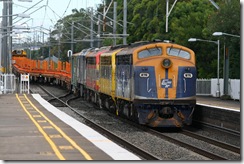
We dashed into the rented Mitsubishi and headed to Heathcoate station, where the train shunted (that’s “switched,” American readers) their head end cars through a crossover south of the station, pulling by our impromptu photo line a few times, before parking the train. The crew were whisked away by a van, and that, dear reader, was that.

Flush with success, we negotiated the maze of highways (that was the 6 to the 5 to the 7 to the 4) and headed off towards Victoria Falls to pick up "reknowned rail photographer" Charlie Harris, known for his perfectly lit action shots of Aussie rail subjects who drives “horizontal elevator” commuter trains for CityRail for a living. Charlie would be our tour guide for the next week. We climbed into the Blue Mountains on a twisting four-lane road, choked with Easter Weekend traffic, driving in a out of brief rain squalls. As the highway climbed higher, traffic—especially eastbound—got heavier. We zipped by Charlie’s home (his backyard is the double-tracked mainline across the mountains) and avoided much of the traffic by taking the old highway down into Lithgow, the western end of the electrified interurban passenger district.

IMG_2975

Roadsigns to familiar, but yet unknown places. . .

We were bound for Orange, around 190 rail miles west of Sydney, where we’d overnight and be in position to chase a Rail Transportation Museum passenger special back east the next morning behind vintage Alco cab units. We were in no hurry for the rest of the afternoon: the weather was crap, and no trains were out and running on the Main West line we’d be following. Charlie led us on a series of backroads to places I’d only known through his photography: the amazing horseshoe curves at Sodwalls, the preserved NSWGR station site at Tarana (unused anymore, but in immaculate condition), the arched brick overbridge at Brewongle.

IMG_2987

Tarana: with the requisite Hotel/Pub on the hill behind. . .

IMG_2988

Preserved station at Tarana: you’d never find this in the U.S. . .

The recent rains had made the hills electric green—rare for early fall. The twisted trees and rolling hills accented by a curving railroad paralled at times by a challenging two-lane paved road seemed oddly familiar to me. Tehachapi Pass in California, perhaps? Dick Steinheimer would’ve seemed quite at home here.

IMG_3004

Beautiful drop-under light at the brick bridge at Brewongle. .

IMG_3015

XPT arrives at Bathurst. . .

IMG_3017

. . .and a big crowd waits on the platform.

The sun broke out a couple of times creating a stunning landscape in front of us, but had set by the time we arrived in Bathurst and stopped by the station for the evening arrival of the “high speed” XPT train from Dubbo. A surprizingly heavy holiday passenger load was waiting on the platform for the regional “Country Link” service.

From there, it was on to Orange and a room for the night.

* * *

H1NI: WTF???

Call it what you want, I’m calling this latest “health emergency” the swine flu, even though the Centers For Disease Control remind us, it’s more accurate to term it “H1N1.” Whatever.

piggy

Let’s don’t demean the swine, eh?

I’m not impressed by this latest “outbreak.” It seems like it’s already fizzling. . .ha, some “pandemic!” As typical, Americans have overreacted—er, erred on the side of caution. My kids’ baseball games have been cancelled for the weekend. Schools in Fort Worth are closed for the next couple of weeks, administrators not wanting blood on their hands should any kids actually get sick and die. . .meanwhile, the kids can spend their little vacation congregating at the mall to spread the virus to each other.

I guess I won’t really believe that it’s Public Health Hazard Number One until one of my neighbors dies from it. Until then, we’ll all be held hostage by politicians and bureaucrats who have to DO SOMETHING because the public is worried.